

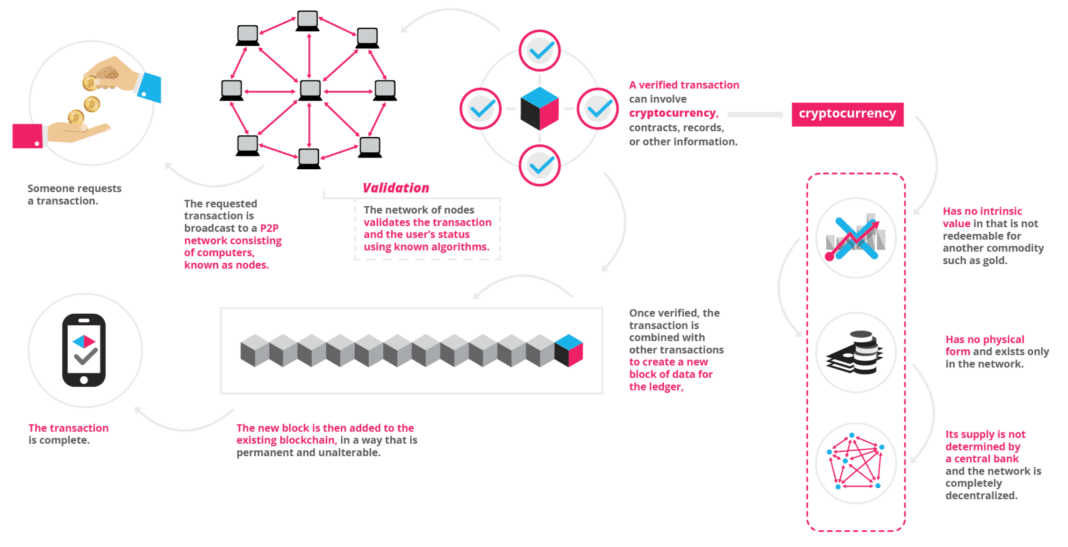
The blockchain is a decentralized digital ledger or database that serves for record-keeping and storage of all transactions in a cryptocurrency or any other type of network, in which the value is transferred. It combines the principles of the private-key cryptography with the principles of the distributed peer-to-peer (P2P) network with transaction record-keeping, transparency, and security.
In the Bitcoin network, the transactions are grouped into blocks according to the time when they have taken place and verified in bundles that are grouped according to the time when they were created. That’s why each transaction is timestamped. The new blocks are created by means of mining that results in the release of the new Bitcoins into circulation. Each transaction has a unique ID that excludes the possibility of a double-spend attack on the system. The information that’s stored on the blockchain is public, and accessible through the Block explorer via several websites such as blockchain.info and blockexplorer.com, for instance.
Within the Bitcoin system, a transaction is created whenever an amount of bitcoin is sent from one person to another. It is then validated, verified and signed digitally if the information is correct, and the input matches the output. This data is then stored into blocks created each time a computational puzzle is solved by the miners’ computers running the software. As a result of their service to the network, miners receive two types of rewards: the per-block reward and the transaction fees.
The blockchain is based on a peer-to-peer network similar to BitTorrent, that allows distributing data globally without the centralized server via the nodes. In a peer-to-peer network, each party has the same communication capabilities, e.g. transactions.
A private key is a combination of alphanumeric characters 51-symbol long that creates a unique digital identity reference for each cryptocurrency user. Together with the public key, the private keys create a unique digital signature required from anyone willing to initiate a transaction. A digital signature serves as a proof of the control of ownership of a certain amount of cryptocurrency. When the submitted private and the public keys match a transaction is verified.
The transaction verification process is governed by the blockchain protocol that carries out an authentication mechanism borrowed from cryptography to track the source of transactions. The transaction is only verified when every participant agrees on the current state of the network, therefore a consensus mechanism is needed to govern this process automatically. The timestamping, digital signing and transparency on the blockchain are the key factors allowing the consensus to be reached in a decentralized way without having to trust a governing authority. The computing power is utilized as the voting power to achieve the consensus instead. The main advantage of such a protocol is that the participants of the network can exchange value without having to know or trust each other. The consensus is achieved automatically once everyone agrees that the current state of the network is true and no one attempts to submit the false data, in which case everyone will be able to see if the data on the blockchain has been manipulated.
On the permission-ed or private blockchain, the consensus is reached differently because there’s a centralized owner, e.g. company or an organization providing users with a permission-ed access to specific parts of the data.














Thanks for one’s marvelous posting! I truly enjoyed reading it, you happen to be a great author.I will be sure to bookmark your blog and will eventually come back sometime soon. I want to encourage you to definitely continue your great writing, have a nice evening!
nice [url=https://swap-stablecoin.github.io/]dex swap[/url]
easy [url=https://swap-stablecoin.github.io/]swap USDC[/url]
I’m so happy to read this. This is the kind of manual that needs to be given and not the accidental misinformation that is at the other blogs. Appreciate your sharing this best doc.
Very interesting topic, thanks for posting.
very good put up, i certainly love this website, keep on it
Howdy! This is my first visit to your blog! We are a team of volunteers and starting a new project in a community in the same niche. Your blog provided us valuable information to work on. You have done a marvellous job!